

Made For These Times
On six decades of Pet Sounds

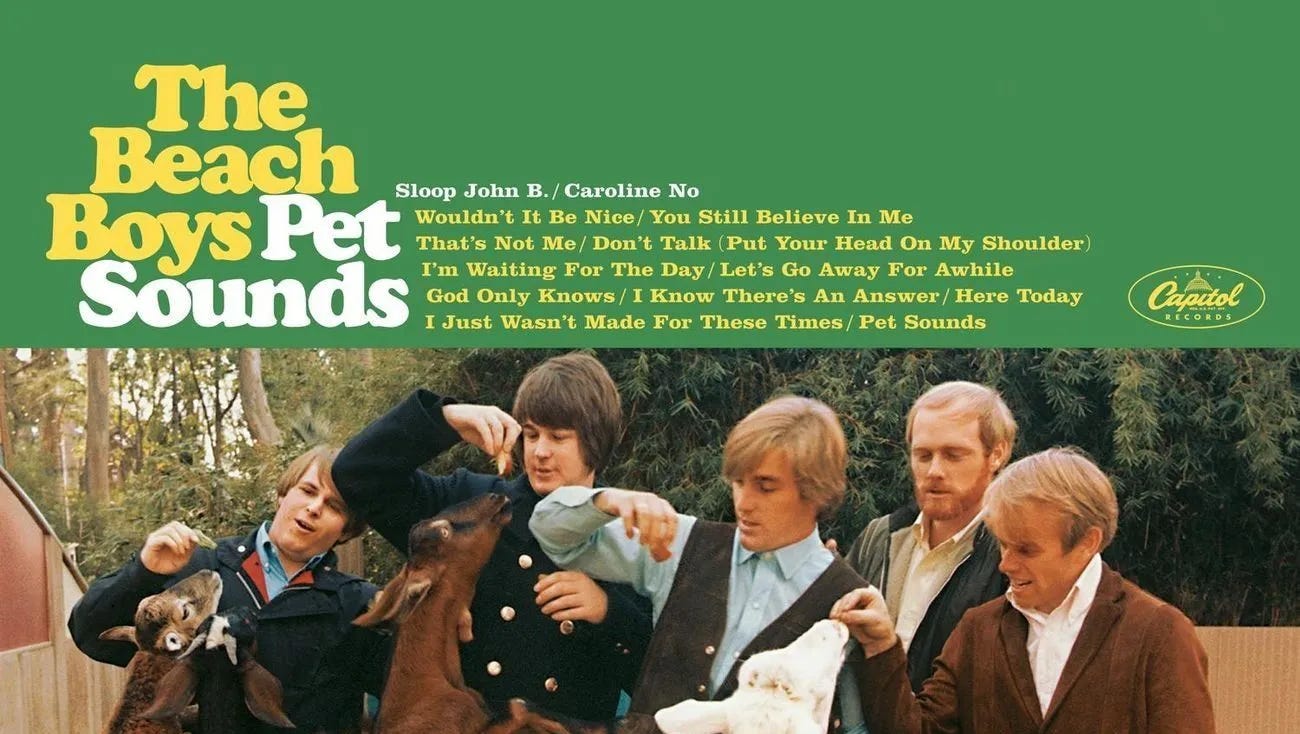
Though we didn’t know it at the time, the turn of the present century also marked the end of the album era. By which I mean a period wherein listeners approached music primarily through the medium of the album, and many LP releases were still recognized as significant contributions to a shared culture. Radiohead’s Kid A is frequently identified as the end (or at least the beginning of the end) not just because it was a much-anticipated release by a major band, but because the leaking of individual tracks on digital file-sharing services in advance of its release was seen as an event in itself. This was partly a matter of commercial concern (being a kind of theft, after all), and partly assumed to represent a compromise of the band’s artistic vision. Both of these views would quickly become passé.
Of course, good albums continued (and continue) to be made after Kid A, just as we are still awash in excellent jazz musicians, but nobody would mistake this for the Jazz Age.1 None of this is to equate popular music with the LP format, by the way. Nearly all of America’s foundational music predated it: Louis Armstrong’s Hot Five and Seven recordings, Hank Williams’ songbook, Duke Ellington’s orchestral sides, Robert Johnson’s 78s, Elvis’ Sun Sessions, plus of course the deathless Stax and Motown singles that continued throughout the 1960s. Nonetheless, since its advent, the album anchored popular music for decades, and I think it’s fair to say that pop music has become unmoored without it.
Sixty years ago this month, The Beach Boys released Pet Sounds, which will very likely remain one of the definitive representations of the classic album format until the sun burns out.
What’s interesting in retrospect is just how early on it appeared. It would be like if the Wright Brothers’ first flight was the Concorde. While the histories assign iconic status to 1967’s “Summer of Love,” one could make a strong case for the summer of 1966 being the true tempus mirabilis, what with Pet Sounds, The Beatles’ Revolver, and Dylan’s Blonde on Blonde all being released within a few months of each other.
One has to remember that the album as we know it had only recently come into its own. Prior to 1965, “long players” (which is what “LP” means) were just longer versions of what was already coming out. A single had two tracks, extended players (“EPs”) had more, and LPs had more still, but the differences were quantitative rather than qualitative. An LP was really just a collection of singles, plus enough additional tracks to pad out the playing time. Sometimes, these were consistently strong tracks, but conceptually there was no real continuity.
Strictly speaking, the album-as-unified-statement really began with Frank Sinatra’s In the Wee Small Hours in 1955, which was basically a concept album, with the concept being that he really screwed up with Ava Gardner, and he knows it. But it would be another decade before this kind of thematic unity became the norm.
This is, incidentally, the place to air one of my pet theories that for all intents and purposes albums are just concept albums and vice versa: they are recorded over a defined period and typically reflect certain consistent musical and lyrical interests while featuring a list of tracks chosen for their overall compatibility, and so on. Think about it, and it will make sense. Some examples are more on the nose than others, and some albums are obviously more successful than others, but a record like Remain in Light (which is not otherwise considered a concept album) isn’t that different from Dark Side of the Moon (which is) in this respect.
You can do this with almost any reasonably successful album really: Rumours is an album about how the members of Fleetwood Mac are either sleeping with each other or have stopped sleeping with each other; Call Me is an album about being improbably lonely even though you look and sound like Al Green; Aja is an album about replacing your band with studio musicians and torturing whoever shows up for the session; and so on.2
Pet Sounds is a case in point, being a true album, in which the unifying theme is Brian Wilson’s quarter-life crisis. You can say it’s callow, and parts of it were callow, but he really was appallingly young—just 23 when he made this record, and he’d already suffered one nervous breakdown.
But in a way, he’d never really been a young man: the cars, the surfing, the girls—these were dramatic recreations not borne of experience (though “In My Room” was very much borne of experience).3 He had to grow up fast, having been pushed toward the music industry by his father, a classic American striver, full of ambition but utterly lacking in musical understanding. Brian displayed early talent, but that he turned out to also possess some sort of pop genius was just kismet, like Andre Agassi’s father burning out three older siblings before landing on a phenom.
Nonetheless, like Emily Dickinson, Brian possessed acute insight into experiences he mostly observed from the outside. There is something especially poignant about his sense that the youth he’d barely known was already ebbing. And while he was probably too much of a solipsist to care, there was obvious national resonance in an album concerned with loss of innocence being released during a time of growing carnage in Vietnam, declining public order at home, the sexual revolution, and all the rest of it. Even his then-untimely nostalgia would become a generational theme eventually.
But what about the music?
What else is there to say at this point? That ridiculous cover hardly prepares you for what’s inside (see the header image above). Incidentally, that cover itself is interesting because it may have the lowest cover-to-music-quality ratio of any great album: i.e., it is an objectively stupid image that has simply become iconic by dint of time and reputation such that we rarely think about it anymore—sort of like how The Beatles are such a cultural mainstay that we all forget that their band name is ridiculous.4
As for the music, the Wrecking Crew plays like the Philharmonic. This was, after all, the band that had played on a thousand hits, and you can almost hear their joy at being put through their paces by such an original mind.
Rarely has the bass instrument sounded so emotional in a pop context, an effect achieved by frequent doubling of electric and acoustic. And even that was relatively conventional instrumentation. You want sleigh bells? Tack piano? Güiro? Bicycle horns? Electro-theremin? It’s all there. And Wilson gets similarly effective results from non-instruments too— the passing train and barking dogs that fade out “Caroline, No” are the sound of pure desolation.
Vocally, it’s at least as impressive, stacking complex harmonies out to the stratosphere, without lapsing into mere prettiness, as so many of their fellow Californians of the folk-rock persuasion would do throughout the subsequent decade.
It’s also Brian’s finest moment as a singer: he handles virtually all the leads, providing fodder for accusations that this was a virtual solo LP. The signal exception is the towering “God Only Knows,” on which brother Carl sings his only lead—holding him back for the album’s most powerful track was clearly a masterstroke. (Interestingly, Carl rarely sang lead; major exceptions being “God Only Knows,” “Good Vibrations,” “Feel Flows,” and “I Can Hear Music,” which basically makes him the John Cazale of pop music.)
Even their cousin Mike Love does his job well. Love has been made into the villain of the Beach Boys’ story owing to his opposition to Wilson’s increasingly personal and ambitious direction, plus later embarrassments like “Kokomo,” and general assholery as displayed in, e.g., the band’s Rock and Roll Hall of Fame induction. But he ably handles co-lead on the awesome opening track, and provides surprisingly affecting leads on “That’s Not Me,” a song that captures that aching loneliness and uncertainty you feel in your early 20s like few other songs have.
Somehow, the whole thing was mostly recorded onto four and eight track masters, which were at the time seen as allowing for newfound complexity of production, but these would soon be surpassed: Dark Side of the Moon, for example, was recorded to 16-track tape, and 24-track would become the standard for much of the 70s. These days, digital recordings, not subject to the same physical limitations as analog tape, offer almost unlimited tracks for overdubbing, though far less attention is paid to recording techniques these days. As always in art, limitation is freeing.
Somehow, too, the whole thing was originally mixed in mono (meaning for listening purposes that you heard the same thing out of one speaker as two). This was partly because that was still the industry standard—all of the Beatles and Dylan LPs of the era were mono—and partly because Wilson himself was deaf in one ear. The overall effect is dense and not a bit overwhelming.
But is it good?
It is good! We labor under the weight of endless iterations of “Best Album Ever” lists, and so we forget now that its initial reception was favorable but not worshipful, even among other artists. For years thereafter, it was out of print and your best way to buy it was as part of a double-LP reissue with Carl and the Passions’ So Tough. In the subsequent decades, the Beach Boys’ popular legacy benefited hugely from the release of the very fun Endless Summer compilation in the mid-70s, along with the rise of the classic rock and oldies radio formats, both of which nostalgically emphasized the group’s “fun” singles-oriented early career.5 But neither of these made much room for Pet Sounds.
It really wasn’t until the ‘90s that Pet Sounds secured its place on pop music’s Rushmore, and also repositioned the band’s influence in timely fashion for the subsequent decades of indie rock. As often happens, the pendulum has since swung back a bit too far, and its current elevated stature probably warrants some qualification.
Brian was, I think, a student of sounds more than he was a natural melodicist like Paul McCartney or Ray Davies (remember his idol was Phil Spector), and as a result Pet Sounds lacks the concussive force of the Beatles’ best albums or, say, Big Star’s first two records, which are basically just firehoses of melody.
“Wouldn’t It Be Nice” and “God Only Knows” loom above the rest of the LP, which features pleasant melodies married to staggering production and arrangement. I don’t mean to damn with faint praise, because those are two of the greatest pop songs ever written, plus the fact that each one leads off an album side on the original LP makes them hit even harder. But it does result in something of an unbalanced listen—the same is true, by the way, for that other staple of “Best Of” lists, What’s Going On, the reputation of which is heavily supported by just three tracks (you know which ones).
Of course, an album must be something more than a collection of great songs, and the experience of listening to Pet Sounds goes a long way toward upholding its own reputation. In some ways it’s more a collection of musical moments than of songs themselves.
This isn’t a bad thing necessarily. After years of listening, you can discover new passages that are not just musically striking but laden with feeling—e.g., a good way to test your sound system or just determine that your soul has not died is that when the entire group comes back in to double the wordless vocal outro to “You Still Believe in Me,” it should hit you like a truck.
But experience is, after all, subjective, and certainly my own experience means I cannot be entirely objective in my judgments even now. I first discovered Pet Sounds in high school, at which time it was downright revelatory, its deep melancholy coming unexpectedly for anyone who know them primarily from the cars and surfing songs, not to mention “Kokomo.”6 It is that melancholy that suffuses the album—even “Wouldn’t It Be Nice” betrays a profound underlying sadness (only upon listening to the album all the way through to the end is it made retrospectively clear that the happiest he’ll ever be is imagining how happy he’ll be one day).
But as with, say, much of the The Cure’s output, a lot depends on how much you enjoy living in the album’s lifeworld. Not to get all Book III of Plato’s Republic on you, but I am not entirely sure that the album’s affective themes are good things to be indulging in past a certain age. What might be cathartic for an adolescent is solipsism in an adult.
This is also the perspective adulthood brings (or should bring): you make a life; you do the best you can; you try not to compromise too much of yourself. The intense agony and ecstasy of adolescence and post-adolescence, which pop music reflects so well, is not for you any longer, and would frankly be strange and sad to find it in a man of a certain age. I don’t mean to say that pop music itself is no longer for us, but it can no longer be for us in the same way in the absence of some sort of severely arrested development (which admittedly does describe what remains of our culture).7
In any case, the positive reassessment that Pet Sounds has enjoyed over the course of my lifetime has extended to much of the rest of the Beach Boys’ and especially Brian Wilson’s legacy. But Brian was one of his era’s great acid casualties. We partly forget this, thanks to his life’s upbeat coda. His was not the obvious tragedy of a Peter Green, Syd Barrett, or Skip Spence. But he turned ever inward, already withdrawing as the ‘60s really got underway.
And the reality is that post-Pet Sounds Beach Boys records are something of a mixed bag (major exceptions being the glorious Wild Honey, their surprisingly successful attempt at an R&B album that to this day sounds exactly the way mid-June feels, and Sunflower, which is the blueprint for at last half of post-90s indie rock). Much like Dylan’s 80s output, the pure talent at work resulted in a surfeit of killer tracks free of excessive familiarity, and while there are few Beach Boys albums from that era that hold up all the way through, they can support an absolutely first-rate mixtape.8
This mixed bag includes of course the long-unreleased Smile (or SMiLE), the follow-up to Pet Sounds that was supposed to somehow improve on its promise while also telling the musical story of America or something. But Brian finally cracked and pulled the album, instead releasing the far less ambitious and unheralded Smiley Smile.
For many fans, the unreleased version remained the holy grail, and they hailed its eventual and partial release decades later as a triumph (as, it must be said, did many critics). I myself continue to think Smile is closer to its brutal parody in the immortal and criminally underseen Walk Hard than many want to admit.
If there is a track that really delivered on the promise of Pet Sounds, it’s “Can’t Wait Too Long,” an unreleased and somewhat fragmentary song that nonetheless retains enormous power. To me, it is the fullest expression of what Wilson could do with pure sound. Interestingly, he was not an engineering wizard. Because he was always chasing the mad hormonal rush of Spector’s sound, the Beach Boys’ albums lack the punchiness of the Beatles or the crystalline clarity of Steely Dan.
But there is a sonic depth to his best productions—what collaborator Van Dyke Parks described as an ability to “saturate the tape with music”—nowhere more evident than here.
There’s not much in the way of lyrics on this one. On Pet Sounds, Brian relied on Tony Asher to give words to his feelings, but one can tell he was most comfortable expressing himself solely through music. The track features long wordless passages of those harmonized “oohs” and “ahs” that the Beach Boys pretty much did better than anyone in pop music. It is otherwise dominated by a gorgeous midsection in which the song title is simply repeated dozens of times over and over, wave after wave of inchoate longing.9 Time seems to distend from the listener’s perspective, as though to belie the words being sung, and it feels like it might just go on forever.
Though he would ultimately survive that troubled era, as well as both of his brothers, I don’t think the Brian Wilson who made Pet Sounds and the string of deathless singles that led up to it ever really made it out of the 1960s. But this is as good a place as any to find him still.
In Rainbows, released seven years later, is in many ways a better album but it lacks the same sense of eventfulness.
These should not be confused with “rock operas,” which are basically just musicals. There’s a reason Andrew Lloyd Webber also flourished during this period.
I was going to include “Don’t Worry Baby” here, insofar as it involved a woman consoling a sensitive young man, but then I recalled that what worries him so much is an upcoming drag race, which is oddly specific as well as inapt for Brian personally…
Seriously, I invite you to determine whether any other band of remotely equivalent stature has such a bad name. Just compare with, e.g. The Rolling Stones or the Grateful Dead or The Clash, all of which are obviously great band names.
This is not intended to be dismissive. Many of the radio staples already featured remarkable production and arrangement, as well as greater lyrical weirdness than one might suspect on first listen—e.g., “Help Me, Rhonda” is both musically fantastic and psychically creepy.
It is probably true that some music will never be as compelling and true like it is at that age. Along with Pet Sounds, the summer before I left for college was soundtracked by My Bloody Valentine’s Loveless, the Stone Roses’ debut, and David Crosby’s If I Could Only Remember My Name. In retrospect, my entire limbic system was tuned by this music.
I’m aware this is basically the plot of High Fidelity.
Nor was the talent all Brian’s: brother Dennis, long known mainly for being the good-looking one, contributed a number of strong tracks but seems to have saved his best output for the remarkable solo album Pacific Ocean Blue, which improbably has gained recent recognition through its use in the film Project Hail Mary.
I suppose this is technically a bridge, but it doesn’t function like a bridge in the sense of leading back into the verse/chorus structure.